Grams vs Grit: Does Armour Weight Really Slow You Down on UK Trails?
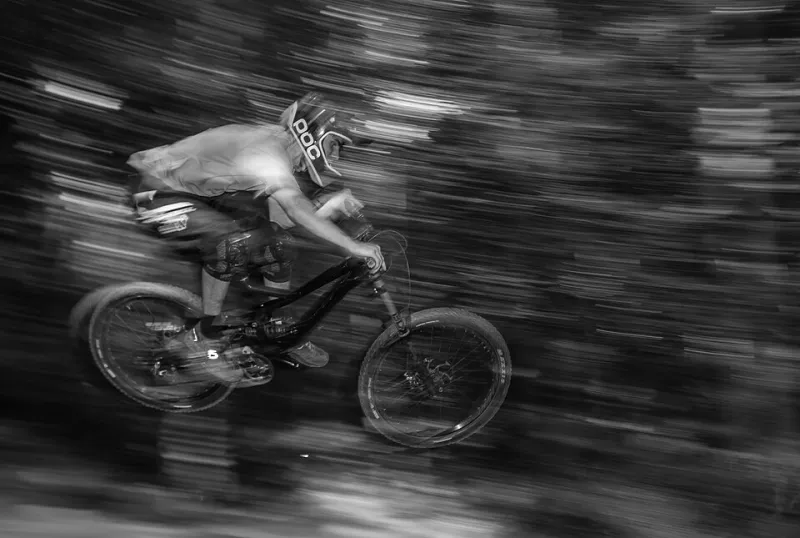
Photo: Jani Brumat deadframe, CC0, via Wikimedia Commons
Stand at the bottom of a trail centre climb in November and everyone looks roughly the same: damp, muddy, and quietly wondering why they wore the thick gloves. Start pedalling and the differences appear. A bulky back protector begins to feel like a passenger. A knee pad that shifts on every pedal stroke drains more energy than a heavier one that stays put. Armour weight is easy to obsess over in the shop and easy to misread on the hill. The useful question is not how many grams, but where those grams cost you.
The penalty is dynamic, not static
A set of armour does not feel heavy in the car park. It feels heavy on the third short climb of the morning, when you are muscling the bike through a rock garden, or when you are pushing up a greasy bit of Peak District singletrack with the bike on your shoulder. Extra mass costs most when you accelerate it repeatedly. On a long descent, a few hundred grams are less noticeable. On a punchy, stop-start UK trail, they add up.
There is also the wet-weight problem. British rides are rarely dry, and foam, mesh and fabric can hold water. A setup that feels fine on a cold, dry morning can gain real weight by lunchtime. That is before mud starts clinging to straps and shells. If you are comparing armour, compare it damp, not just dry.
Where the grams actually hurt
The first place is climbing and repeated efforts. A heavier pack-and-armour combo raises the cost of every acceleration, and on UK trails you are often accelerating out of corners, over roots, or into short steep ramps. The second is agility. Excess bulk around the shoulders and ribs can restrict breathing and rotation; loose padding can drag and catch. The third is fatigue caused by fit rather than mass. A light pad that slides around is worse than a heavier pad that stays put, because you spend the whole ride correcting it.
Hard-shell armour tends to spread impact over a wider area, but it can be heavier and hotter. Soft, viscoelastic pads are more flexible and often more comfortable on pedally rides, though they may need more careful checking after repeated wash cycles. Hybrid setups, with hard caps over softer backing, are the usual compromise. For most UK trail riders, they make sense.
Three common setups, honestly compared
A full hard-shell kit with a separate back protector gives the most confidence for uplift days, bike park laps and rocky descents. It is also the heaviest and warmest, and it is overkill for a flat, rooty cross-country loop.
A hybrid trail kit, with knee and elbow pads plus a lightweight back insert, is the sweet spot for most riders. You get coverage where you are most likely to land, without feeling like you are wearing a suit of plates.
A minimal setup, with thin knee pads and maybe a lightweight spine protector, feels brilliant on the climb and fine on smooth trail centre blues. It is the wrong call for steep, committing terrain or for riders who are pushing their limits.
Cutting weight without cutting sense
Start with fit. If the armour moves, it is costing you. Then look at coverage: protect the places you actually fall on, not every square inch of skin. Choose a setup with removable or interchangeable back panels if you ride different terrain. Check how much water the fabric holds and how long it takes to dry. Keep straps clean and correctly adjusted; a gummed-up strap is a false economy.
Look at the material story too. A soft pad that soaks up water can end up heavier than a hard-shell pad that sheds it. Mesh liners help, but only if they are clean and able to breathe. A pad packed with dried mud is a pad that cannot ventilate, and that means more sweat, more damp, and a heavier-feeling ride.
Finally, do not chase grams at the expense of a proper layer. A well-ventilated base layer and a pack that sits close to your back will do more for comfort than shaving 50g from a pad. The best armour is the stuff you forget you are wearing until you need it. On British trails, that is usually the setup that fits, breathes, and does not turn into a sponge.